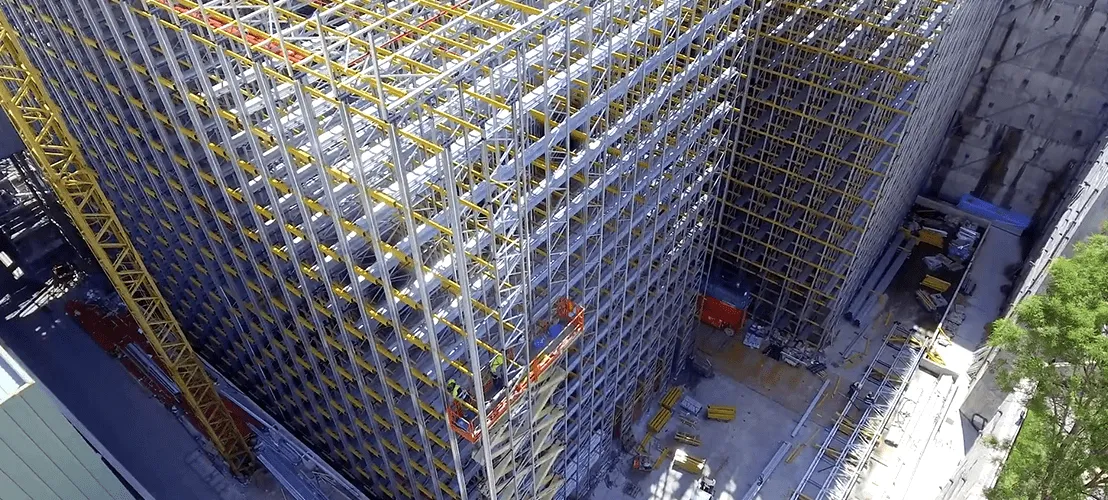
Can you imagine avoiding civil works and all its procedures to create your warehouse? It is possible, with self-supporting storage systems. This type of installation is used for storing goods, but it also represents the main structure of the building and supports its enclosure, thus forming an industrial storage warehouse.
Self-supporting storage systems are high-rise structures where the shelving forms a compact group with the warehouse’s roof and facades, thus avoiding civil works. In these structures, the shelving is the support for the building itself. It is especially recommended when we need to store goods at height, because it allows you to make the most of the available space and volume.
In this article, we analyze the characteristics of self-supporting warehouses and the advantages they offer compared to other types of warehouses.
Characteristics of Self-Supporting Warehouses
- It represents the best solution for warehouses intended to stock the largest number of unit loads.
- Their shelving not only supports the loads of the goods and the handling equipment. They are also subject to the effects of snow loads, wind actions, temperature actions, and seismic actions according to their location.
- The self-supporting warehouse allows for storage with systems operated by manual forklifts or through automated equipment.
- It enables storing goods at great heights, thus achieving better utilization of the available space.
- This type of warehouse improves construction times. Furthermore, it significantly reduces the costs represented by other solutions, such as the construction of a non-self-supporting warehouse.
The Advantages of Self-Supporting Warehouses
The benefits of self-supporting warehouses compared to other types of warehouses are many and varied:
- The most important one is that it equips the warehouse and avoids the civil construction of an industrial warehouse. Therefore, there is no need to erect a building as a preliminary step to installing the warehouse.
- This translates into a lower investment cost, without forgetting that the execution time is also shorter. It is a simple construction and a much cheaper solution than having to build a warehouse from scratch. In short, it is much more cost-effective than a traditional warehouse.
- It is a building designed to fit the necessary measurements, and the design contemplates both the warehouse structure and the shelving at the same time. Thus, space utilization is much greater.
- It can be built to a great height. The only limits are local regulations, or the reach of the handling equipment used. Hence, most self-supporting warehouses include shelving operated by automated handling equipment. For example, stacker cranes or miniloads, with which loads can be moved to great heights with absolute safety.
Safety Above All
Self-supporting warehouses must not only support the loads generated by the stored goods and the stresses derived from the handling equipment. They must also be prepared to withstand the typical actions of a building. For example, the action of wind, roof overloads (from maintenance work, snow fall, etc.), or the dead loads of the structure and the enclosures (both roof and facades). As if that were not enough, the seismic coefficient corresponding to the area where it is installed must be considered.
Self-supporting warehouses, like any other civil engineering structure, fall into the category of building structures. However, with their particularities: in addition to the characteristics of a standard building, the specificities of shelving must be taken into account.
Therefore, in the design and construction of these facilities, not only must the construction standards of each country be followed and the actions that may affect the structure be considered (those already mentioned before such as wind, seismic, or roof overloads, for example). The specific regulations for metal shelving must also be respected.
A solution born from our commitment to innovation
Self-supporting warehouses are special solutions for several reasons:
- They are not standard solutions; they must be custom-designed for each project.
- The calculation programs used in their construction are more complex than those employed for conventional warehouse design.
The study, development, and monitoring of these special projects are carried out at our Technological Center for Research, Development, and Engineering. It is the embodiment of our commitment to R&D.
Success stories of POLYPAL self-supporting warehouses
→ Warehouse for Papel Aralar
We built a self-supporting automated warehouse for Papel Aralar, a company from Gipuzkoa that needed to increase its storage capacity and optimize its logistics processes.
The facility, with capacity for more than 5,300 paper reels (with a total weight of over 10,000 tons), covers 3,000 m² of surface area, 22.2 meters in depth, and includes 15 loading levels in height. It consists of 25 rack modules operated by a shuttle cart system to facilitate reel movement.
The maximum load per level is:
- First level: 1,300 kg/m
- 2nd–7th level: 1,200 kg/m
- 8th–15th level: 288 kg/m
The major challenge in constructing this structure was the peculiar topography of the Papel Aralar site. The new warehouse was built over a pit where all the necessary materials and machinery had to be brought in for assembly. For this reason, the racks were lifted using a self-supporting guide that had to be installed on a nearby hill adjacent to the assembly area.
→ Expansion of a self-supporting warehouse for Chausson Materiaux
The project for this client—a French company specializing in the distribution of construction materials—consisted of two key milestones. Initially, we built a self-supporting warehouse from scratch.
Three years later, the company’s growth and expansion required enlarging the warehouse. The extension work was carried out without interrupting the company’s daily operations at any time.